When I first heard Lecce had the nickname “the Florence of the South”, I have to admit I wasn’t quite sure what to expect. Florence is still high on my list, but I’ve never actually been, so I don’t have much to compare it to. And some of these comparisons can be a bit… ambitious – like the person with a clear sense of humour who once called Opole “Poland’s Venice”, which really makes you wonder whether they’ve ever been to Venice (or even seen a photo of it).
As we were visiting Puglia during a heatwave, we decided to leave slightly later in the day to avoid the worst of the sun. And the moment we got off the train and started walking towards the historic centre, I realised this was a massive mistake. Even a full day might not be enough to see everything Lecce has to offer – let alone half a day.
But if you’re short on time too, here’s my guide to spending a day in Lecce, including what to see, do, and eat to make the most of your time in the Florence of the South.
Let’s go!


Why is Lecce nicknamed “the Florence of the South”?
So, first things first… where did that nickname even come from?
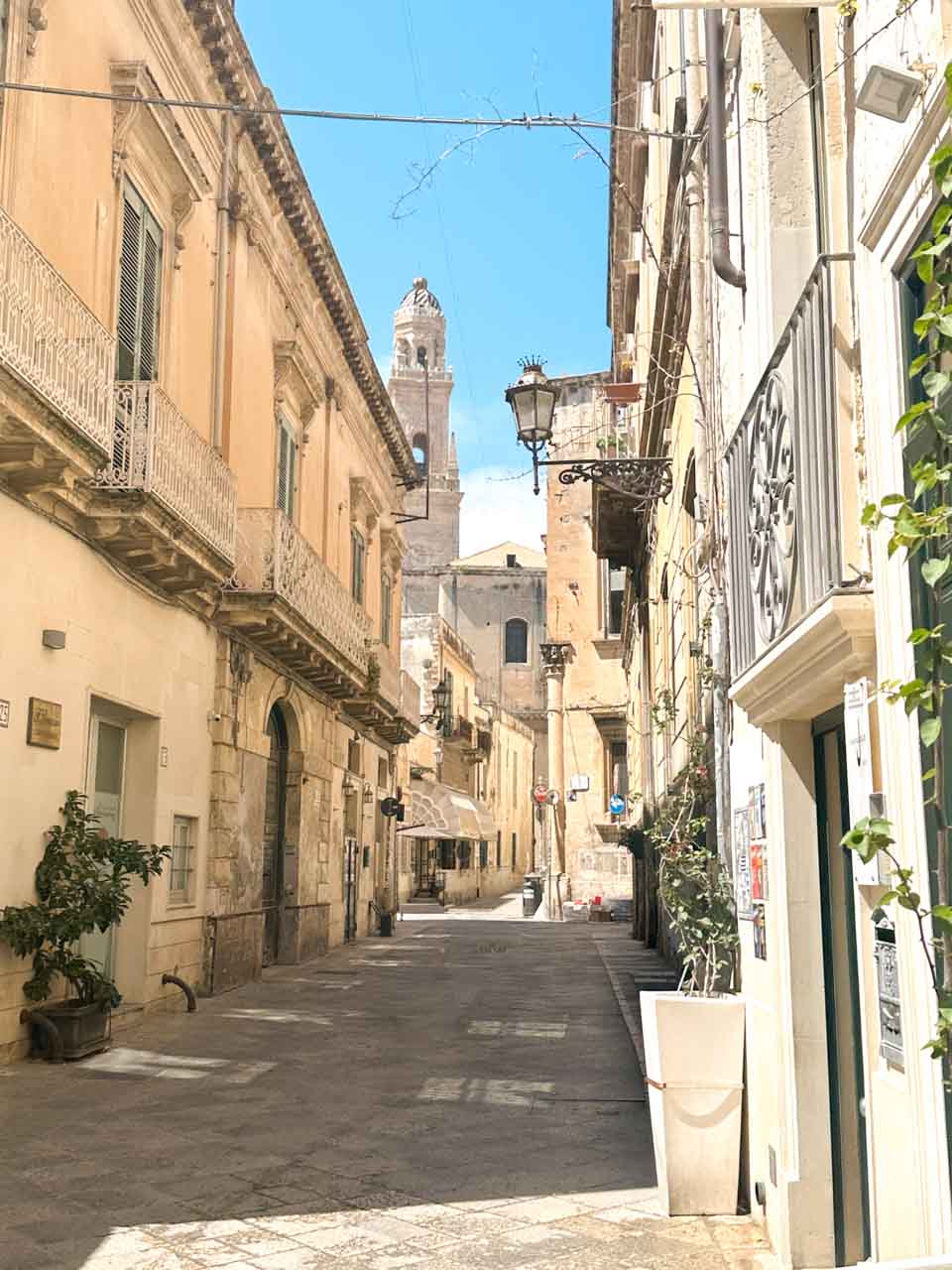
Lecce is often called “the Florence of the South”, and once you start walking around the historic centre, it’s not hard to see why.
The city is full of grand churches and elegant palaces covered in incredibly detailed stone carvings. Almost everything here is built from a local golden limestone called Pietra Leccese, which gives the buildings that warm, honey-coloured glow Lecce is so famous for – especially in the evening, when the light hits them just right.


The Florence comparison mostly comes from the city’s artistic heritage. Florence became the centre of Renaissance art in central Italy, while Lecce developed its own distinctive Baroque style in the south.
How to get to Lecce
Lecce sits right in the heel of the Italian boot, but it’s surprisingly easy to reach from other parts of the country. The closest airports are Brindisi and Bari, both of which have flights to several European destinations.
We were staying in Brindisi, and from there it was only about a 20–30 minute train ride. If you’re staying in Bari, the journey takes roughly 2 hours. We booked all our tickets directly on the Trenitalia website. Regional trains from Brindisi to Lecce start from €3.50 for a one-way ticket, which is pretty hard to complain about.

If you’re travelling from other parts of Italy, there are also direct trains from cities like Venice, Rome, Milan, Turin, Bologna, and Naples. However, if you’re coming from the far north, the journey can easily take 10 hours or more, so it might be worth considering a sleeper train, breaking up the trip along the way, or simply flying.
From the train station, it’s an easy 15-minute walk in a straight line to reach the historic centre. You could of course take a taxi, but unless you’re travelling with lots of luggage, staying on the far side of the Centro Storico, or have mobility concerns, it’s really not necessary.

Where to stay in Lecce
Now, to be fair, we didn’t actually stay overnight in Lecce – but it’s the first city on our list for when we return to Puglia. And when we do, we’ll almost certainly be booking a place there.
One of the main reasons is something called “la pausa” or “riposo”. In many parts of southern Italy, a lot of places close during the afternoon so people can escape the hottest part of the day. We quickly realised that some of the restaurants, cafés, and bars we wanted to try either shut in the middle of the day or only opened in the evening.
So while visiting Lecce on a day trip is definitely doable, it’s much easier when you don’t have to worry about finishing your meal and rushing back to catch a train – especially if you’re travelling from somewhere further away than Brindisi.

The same goes for other towns around Puglia. You can absolutely see them in a day, but it’s worth remembering that some places you want to visit simply won’t be open during certain hours, and you may need a bit of flexibility.
Staying overnight also makes it easier to start exploring in the morning, return to your accommodation during the hottest part of the afternoon, and head back out again later in the evening.
If I were choosing where to stay in Lecce, I’d probably look somewhere in or near the historic centre. Lecce is very walkable, and with views like these around almost every corner, we found it genuinely pleasant to get around on foot. But after a full day of exploring, it’s also quite nice not to have a long walk back to your accommodation.
Here’s a map where you can check and book available accommodation for your travel dates:
Best things to do in Lecce
Note: If you want to visit several of Lecce’s main sights, it’s worth looking into the combined LeccEcclesiae ticket. The basic version costs €11 and includes entry to Lecce Cathedral, the Basilica di Santa Croce, the Church of Santa Chiara, the Church of San Matteo, the Ancient Seminary, and the Museum of Sacred Art (MuDAS). There’s also a €21 option that includes access to the top of the cathedral tower. You can buy the tickets online through the Chiesa Lecce website. While you’re there, you can also download free tickets to visit Museo Sigismondo Castromediano and Convitto Palmieri. If you’d rather buy them in person, tickets are available at the Central Ticket Office and Infopoint in Piazza del Duomo 5 or at the ticket office of the Basilica di Santa Croce. Just keep in mind that reduced tickets are only available on site.
See the city gates
Historically, there were 4 gates leading into the historic centre of Lecce: Porta Napoli, Porta Rudiae, Porta San Biagio, and Porta San Martino. Unfortunately, the last one didn’t survive – it was destroyed in the 19th century.
If you have the time, I’d definitely recommend walking past the remaining gates while exploring the city. My personal favourite was Porta Napoli, also known as the Triumphal Arch, which was built in the 16th century on the route leading to Naples. We happened to pass by just before sunset, and it looked absolutely magical in the soft evening light.


If we’d had a bit more time in Lecce, I would have loved to linger around that area. There seemed to be several cute restaurants and bars nearby, and it was noticeably livelier than when we were wandering around the city earlier in the afternoon. People were slowly coming back out for dinner, and the whole place felt like it was waking up again after the heat of the day.
So if you’re planning to eat somewhere in the historic centre, it might be a good idea to book a table in advance.
Lecce Cathedral
Lecce Cathedral, or the Duomo, is one of the city’s main landmarks. It was originally built in the 12th century and then rebuilt about five centuries later in the Baroque style we see today.


With your ticket, you can first see a small display of sacred objects before continuing on to explore the cathedral itself and the crypt.
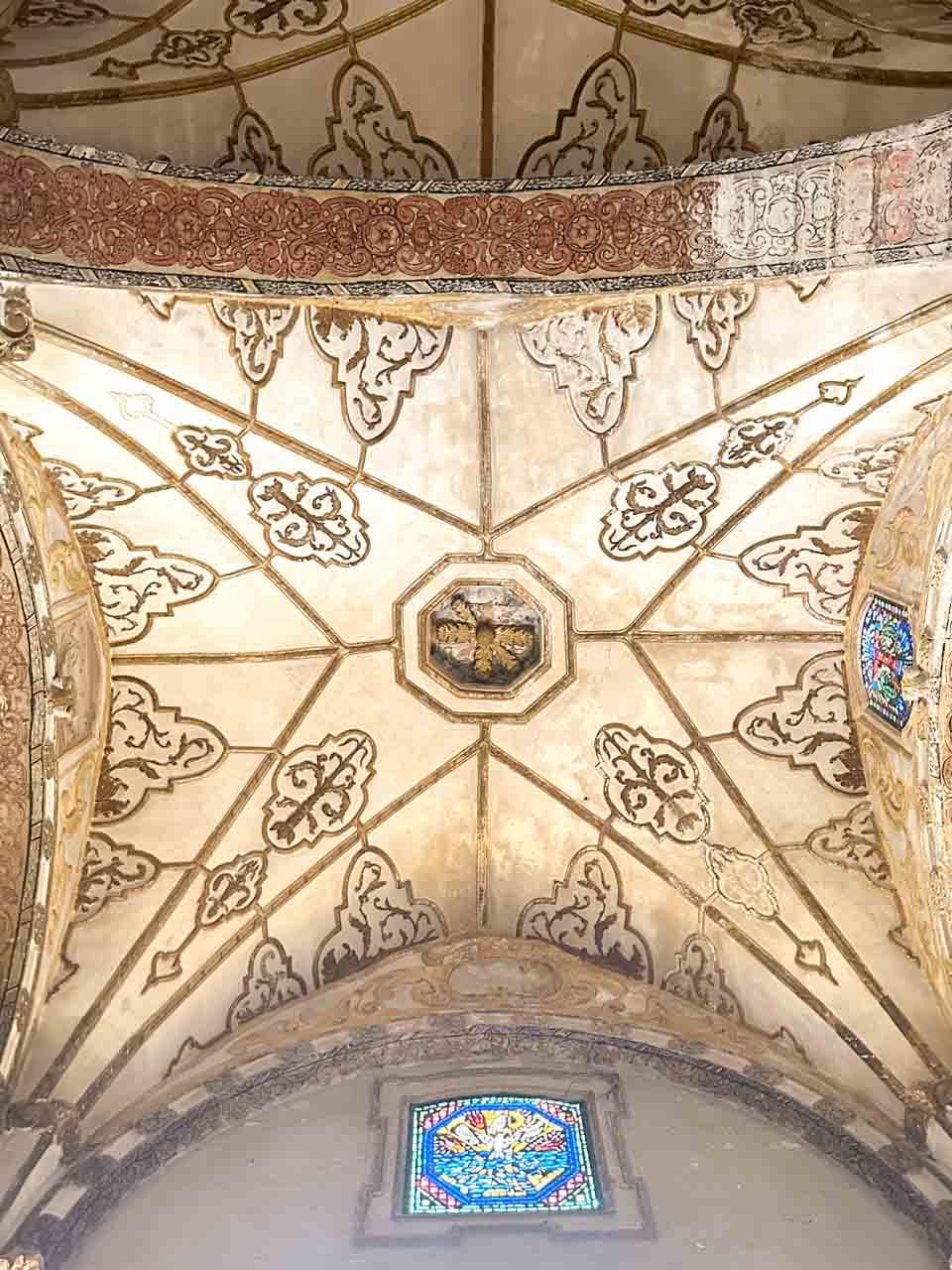
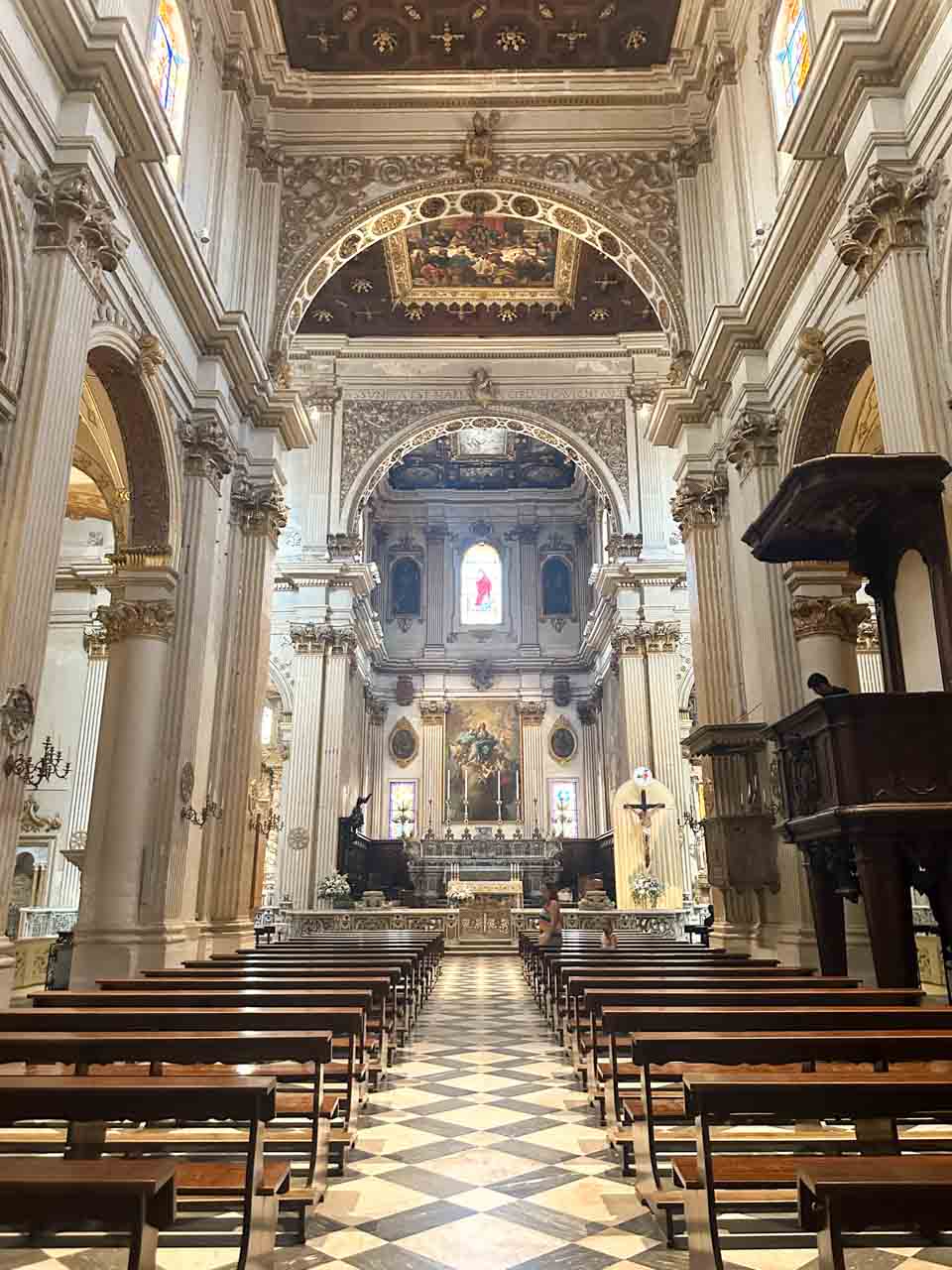
Inside, there are several beautiful side chapels, and the ceiling features a pretty funny version of The Last Supper by Giuseppe da Brindisi. If you look closely, it seems like one of the apostles is either playing with (or feeding) a cat under the table – which I found oddly relatable and quite heartwarming. 😉


Since I rarely skip an observation deck when one is available, we decided to go for the slightly more expensive ticket that includes access to the cathedral tower. However, I have to admit… I didn’t enjoy that experience nearly as much as I expected.
Now, don’t get me wrong — the view itself is beautiful, and on a clear day you can even spot the Adriatic Sea in the distance. But I’m not sure whether we were just unlucky or if it’s always like this, because the wind up there was absolutely brutal.

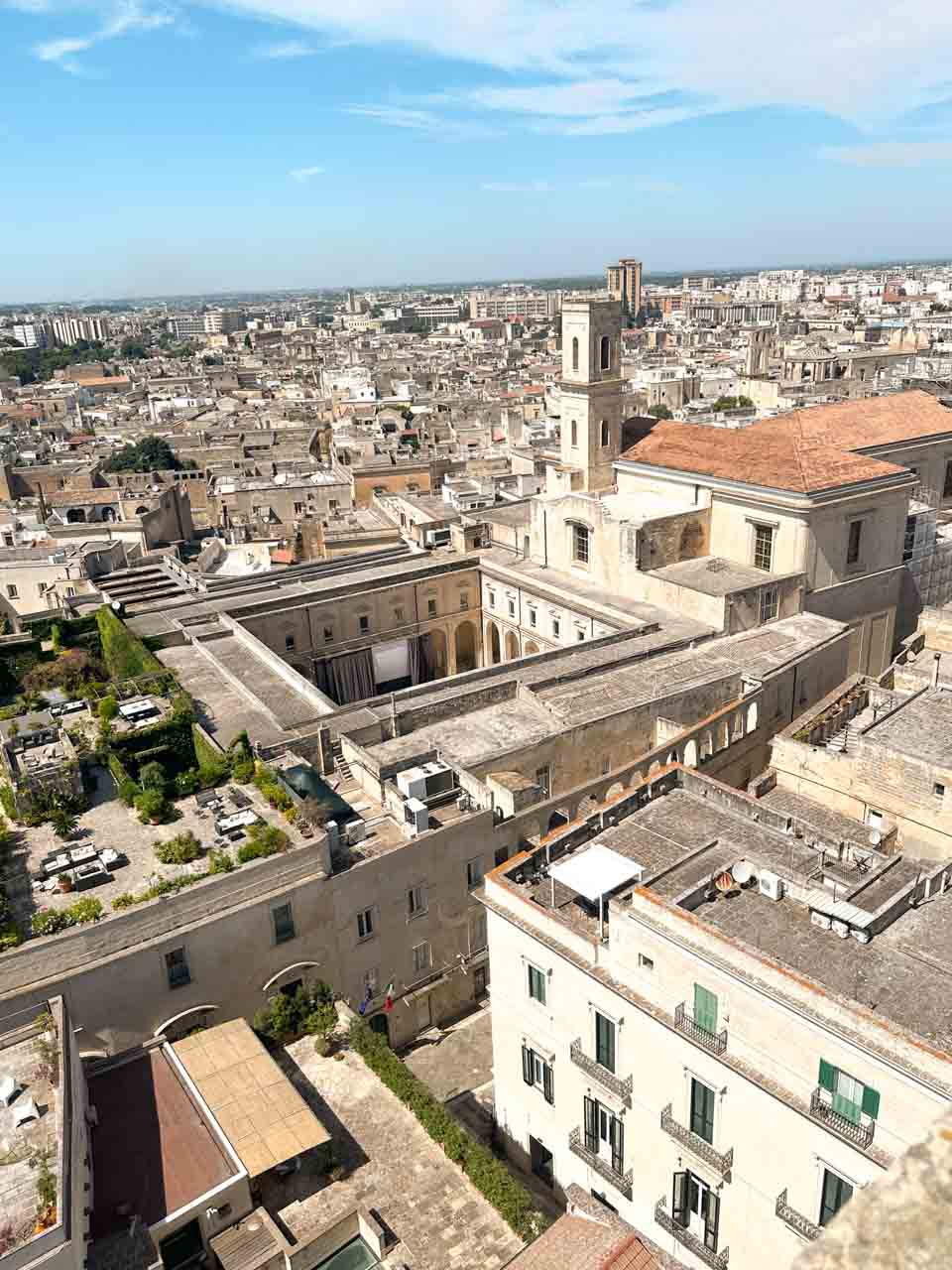
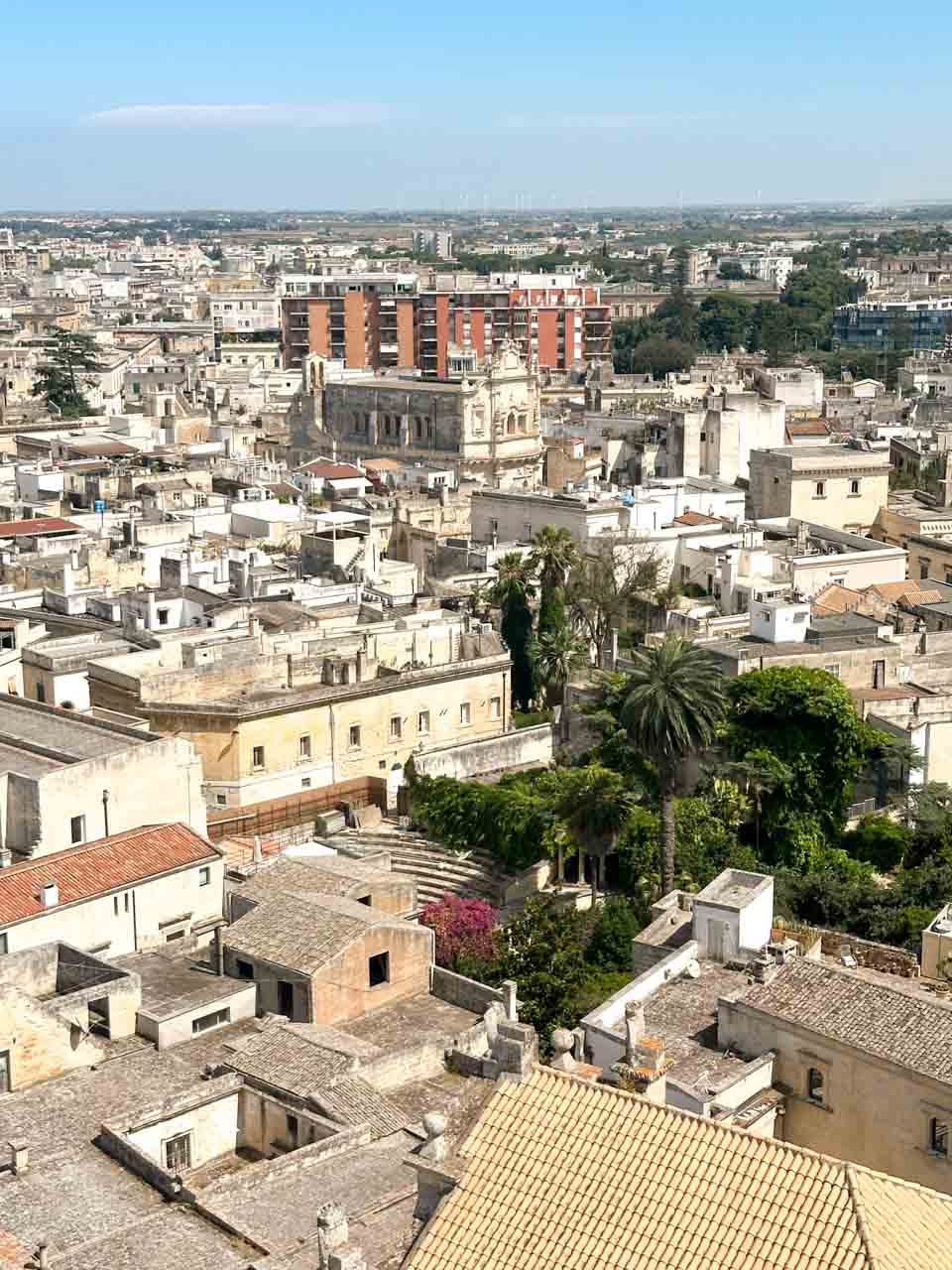
I ended up hastily tying my hair up because my hair and clothes were flying in every possible direction. It was honestly a bit difficult to focus on the views when the wind was battering us like that. I’ve been to plenty of windy observation decks before, but this felt like a whole different level. We snapped a few quick photos and made a quick escape – and I genuinely felt for the staff who had to stand up there for an entire shift.
Basilica di Santa Croce
The Basilica di Santa Croce is one of the most recognisable sights in Lecce. It dates back to the 17th century, and its most distinctive feature is the large rose window in the centre of the façade.
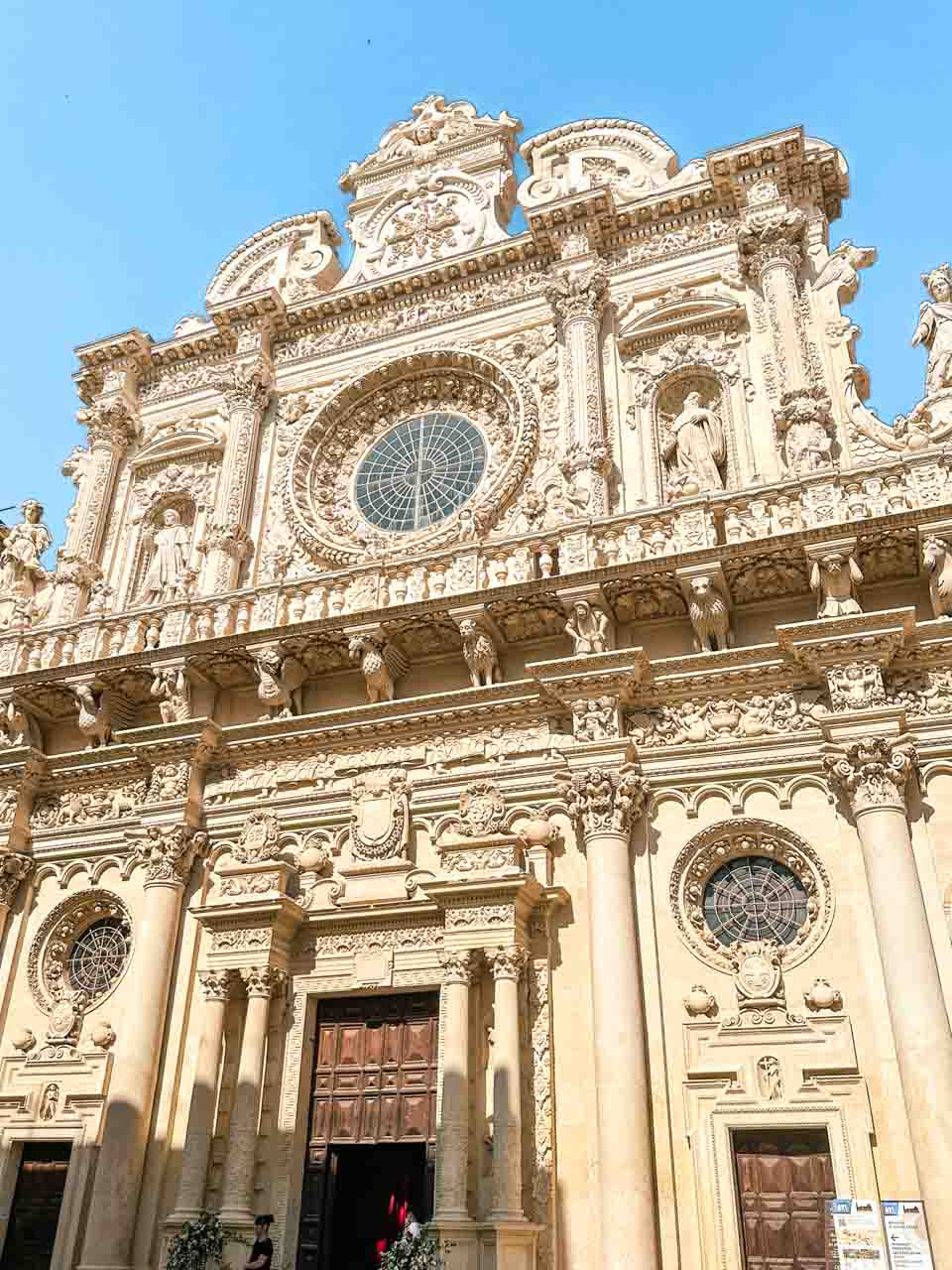
You can also visit it as part of the LeccEcclesiae ticket. Alternatively, in the afternoons there’s a special guided tour that allows you to see the basilica from its terrace for €12. On Fridays, there’s also an artistic installation combining light and music that you can attend for €15. You can purchase tickets for both events on the Chiesa Lecce website.
Unfortunately, when we arrived, there happened to be a wedding inside, so the basilica was closed to visitors. But instead of feeling disappointed, I mostly took it as a sign from the universe that I should come back to Lecce one day.
And to be fair, standing outside and admiring the incredibly intricate façade – along with the impeccably dressed wedding guests – was already a feast for the eyes. Honestly, how special must it be to get married somewhere like this?
Ancient Seminary and MuDAS
Another place we visited as part of the LeccEcclesiae ticket was the Ancient Seminary, which also houses the Museum of Sacred Art (MuDAS). I’ll be honest – this probably wouldn’t have been very high on my list otherwise, but we figured that since we already had the ticket, we might as well see what it was about.
One part I really enjoyed was the Seminary Palace cloister, with its well right in the centre. When we were there, a group of young people were lounging around it, chatting and relaxing, and for a moment it almost felt like being on a beautiful university campus with that kind of laid-back energy.
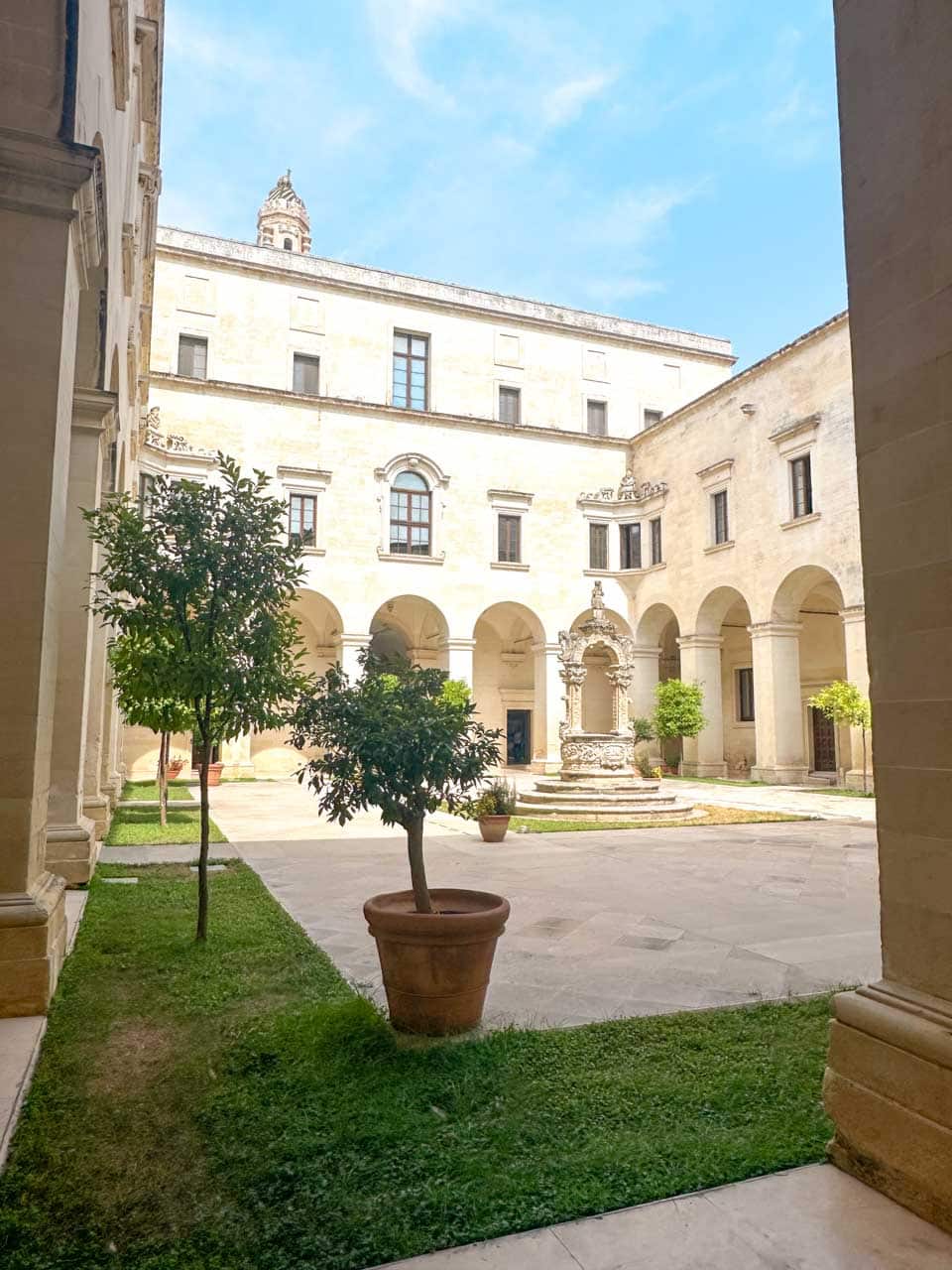

Upstairs, you’ll find the Museum of Sacred Art, with paintings, sculptures, and various liturgical objects. It’s not necessarily my cup of tea, but there are still some interesting pieces to see – and we had a surprising amount of fun trying to guess which sculptures were made of papier-mâché. In the end, though, we genuinely couldn’t tell them apart, so whether we were right or completely wrong remains a mystery.


On the ground floor, there are also a few rooms displaying contemporary art. Again, contemporary art isn’t really my thing, so I probably wouldn’t say this is a must-see if you’re paying separately. But if you already have the combined ticket, it’s a lovely place to step out of the heat for a while, admire some beautiful interiors, and learn a bit more about the role religion has played in this region.


Chiesa di Santa Chiara
The last place we visited with our ticket was the Church of Santa Chiara. At first, it might seem like just another church – the kind you’ll see plenty of while travelling around Italy. But then you look up.

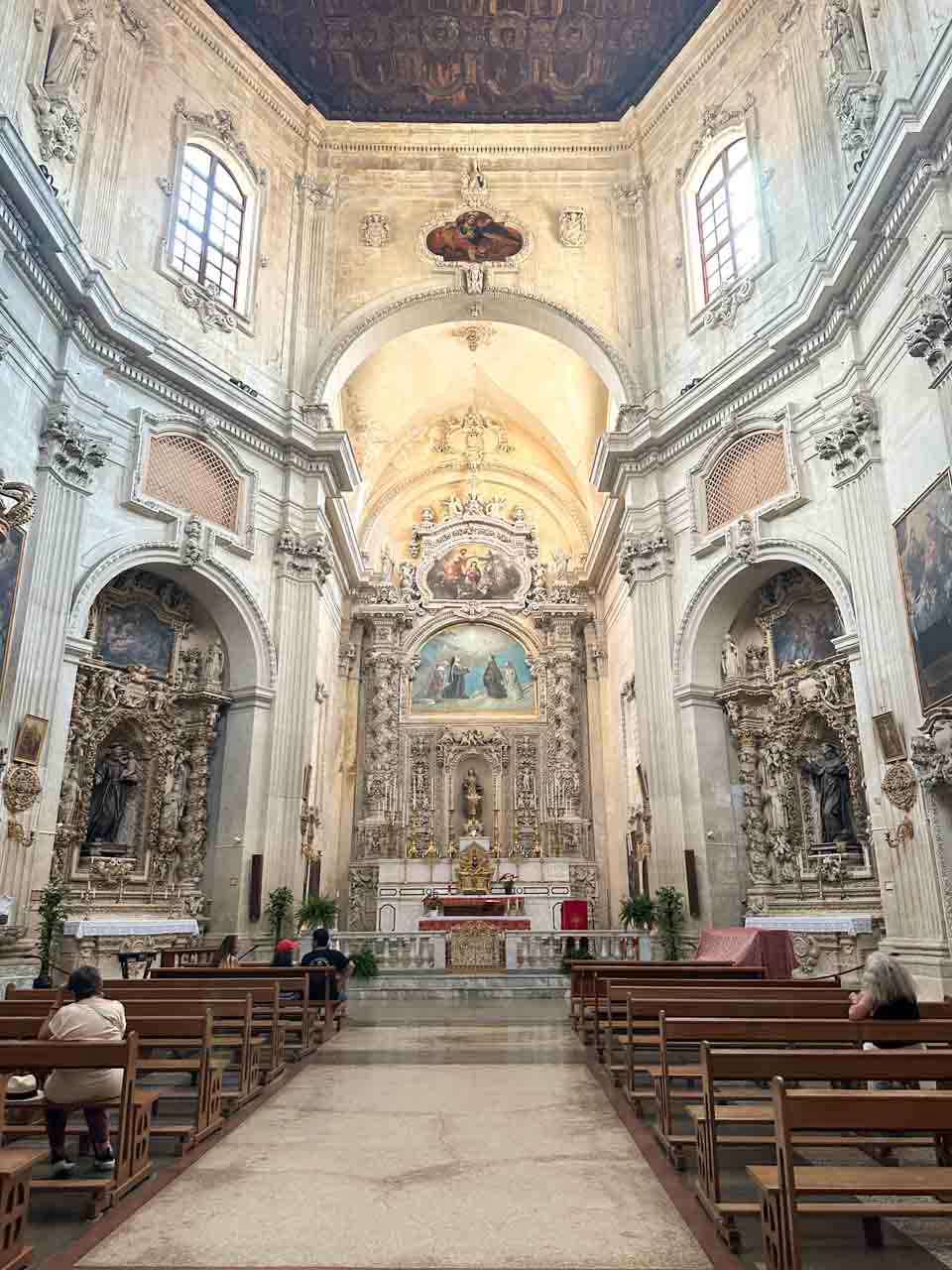
As I teased in the previous section, one thing you should know about Lecce is that the city is famous for papier-mâché, or cartapesta.
The technique became popular in Puglia because churches needed decorations but couldn’t always afford expensive materials like marble or bronze. Instead, artisans used shredded paper mixed with water to create a pulp, which they could then shape into different figures as it dried.
And that’s exactly what you’re seeing here. The “wooden” ceiling above you isn’t wood at all. Local artisans created it from papier-mâché and shaped it to look like wood!
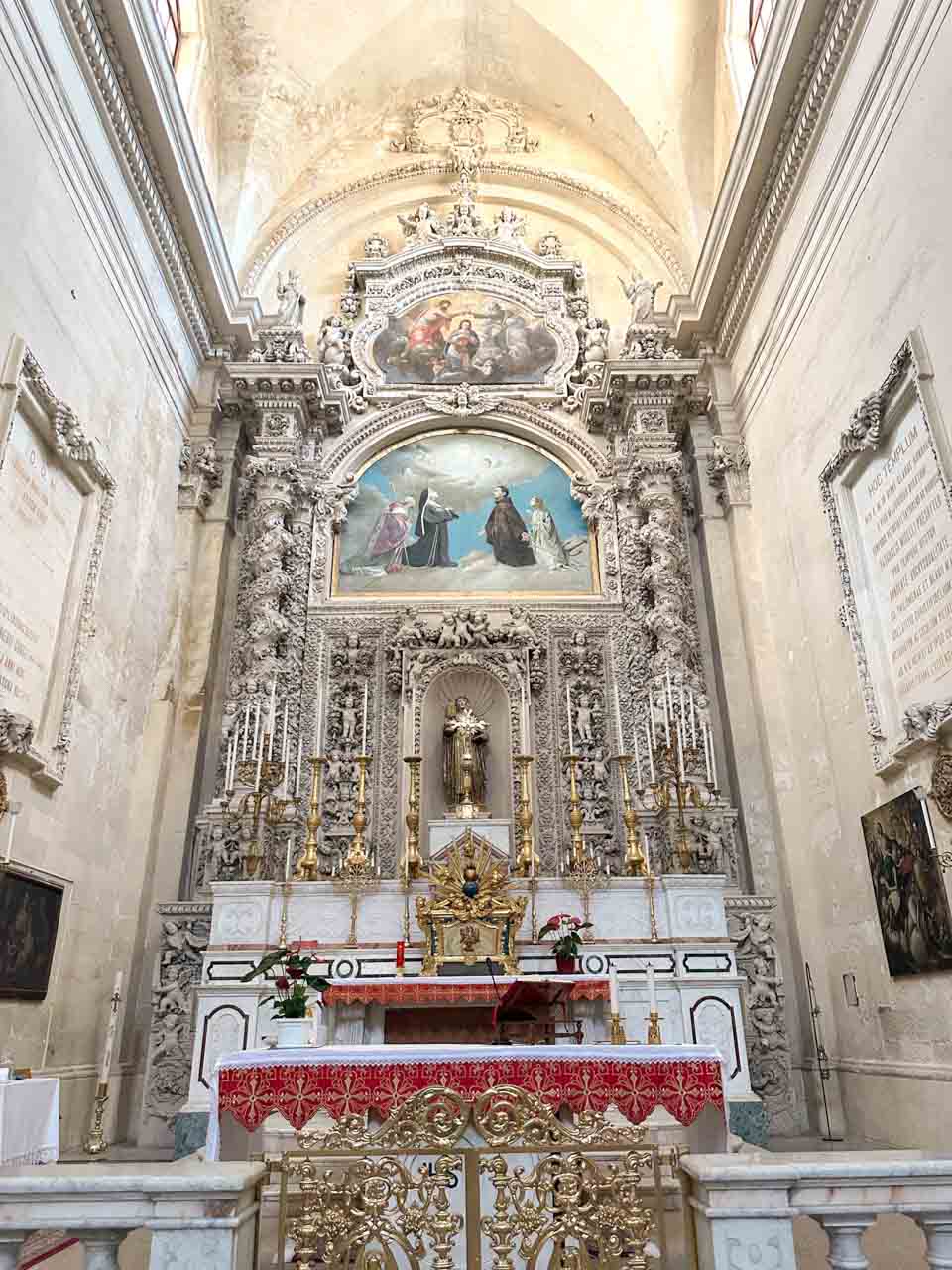

Once you realise that, the whole place suddenly feels even more impressive. I genuinely couldn’t stop staring at the ceiling, trying to wrap my head around the fact that they created all that detail from paper.
If you’d like to learn more about this traditional Lecce craft, you can also visit a family-run workshop called Cartapesta Riso.
Or if you’re feeling creative, you can attend papier-mâché workshops, where you can try making your own little souvenir.
One small practical tip: if you buy your tickets online, I’d recommend taking a screenshot. Ours came as a URL rather than a downloadable PDF, and it randomly expired before we managed to visit the Church of San Matteo. We’re still not entirely sure whether it was because the remaining sites weren’t available or simply a technical glitch, but it’s definitely something to keep in mind.
Museo Faggiano
Out of all the places you can visit in Lecce, this one probably has the most unusual backstory. It all started when Luciano Faggiano bought a house with plans to turn it into a restaurant. Before he could do that, though, he needed to fix a plumbing problem. So he and his sons started digging up the floor, trying to locate a faulty sewage pipe… and quickly realised they were standing on 2,500 years of archaeological history!


Over the next 7 years, the Faggiano family financed and carried out excavations with the help of a local archaeologist. And while they eventually did find the stubborn pipe that started it all, they also uncovered more than 5,000 artefacts dating back to the 5th century BC.
Among the discoveries were a Messapian tomb (a tribe that lived in the area long before Roman times), a granary, an eight-metre-deep well, the remains of a Franciscan convent, ancient rings and vases, hidden frescoes, etchings attributed to the Knights Templar, an underground tunnel believed to lead to the Roman amphitheatre, and plenty more.


Today, it’s the only independent museum in Lecce, and you can explore it for €5. I found it to be a really fun experience, because you genuinely feel a bit like an explorer yourself. You get a map showing the order in which to visit the rooms, along with short explanations, and then you can walk through the entire house – from the basement all the way up to the rooftop tower.


And in case you’re wondering what happened to the restaurant idea… yes, Luciano Faggiano did eventually open a trattoria called Quo Vadis right next door to the museum. Although this time, he decided not to dig under the floor – just in case. 😉
Roman Amphitheatre of Lecce
As you’re planning your trip to Lecce, you might notice that there are two similar-sounding attractions and wonder if they’re actually the same place.
I had the exact same question while doing my research, so let me save you the trouble: no, they’re two completely different sites. There’s the Roman Amphitheatre of Lecce, and then there’s the Roman Theatre (Teatro Romano).
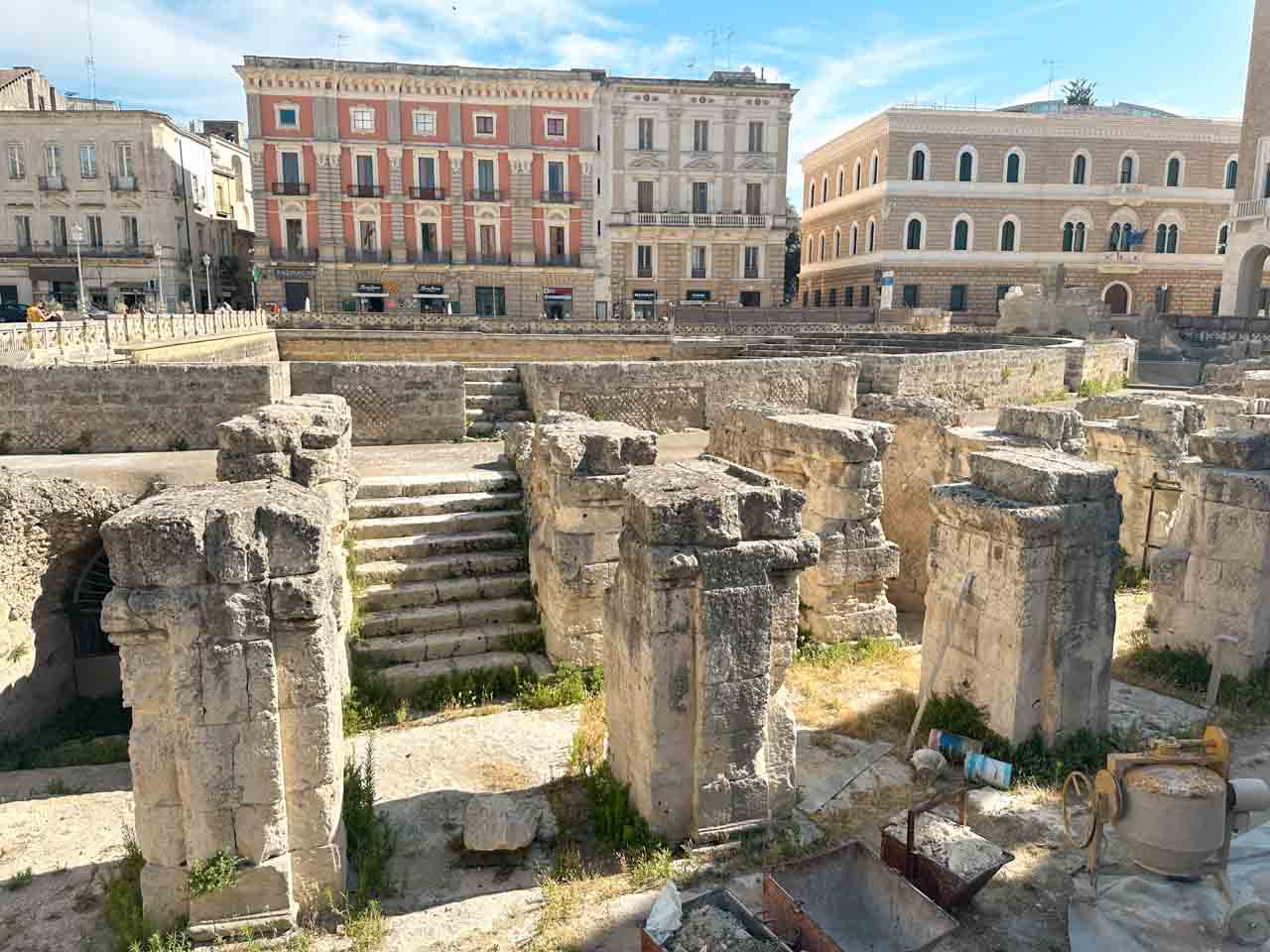
You’ll find the amphitheatre right on the city’s main square, Piazza Sant’Oronzo. You’ll recognise it easily thanks to the Column of Saint Oronzo, the patron saint of Lecce, who – according to local tradition – saved Brindisi from a plague in 1656.

If you’ve read my Brindisi guide, you might remember that after an earthquake in the 16th century, one of the city’s famous Roman columns collapsed. After the plague ended, Brindisi gifted the remaining pieces of that column to Lecce, and they used them to build the monument you see in the square today. The column standing there now is actually a replica, while the original fragments are in the municipal building on Via Francesco Rubichi, just nearby.

The amphitheatre itself dates back to somewhere between the 1st and 2nd century AD. Interestingly, people didn’t even know it existed until 1901, when construction workers stumbled upon it while digging foundations for the Bank of Italy building. At its peak, it’s believed the arena could seat around 15,000 spectators (although some sources claim it may have even been closer to 25,000).

Today, about half of the amphitheatre is visible from the square, while the rest still lies underground. The city still hosts occasional events here, and guided tours are sometimes available. At the moment, the site is under renovation, so it’s not possible to go inside – but you can still get a very good view of it from the street.
Roman Theatre
The other theatre in Lecce is the Roman Theatre, located just a short walk away near the Church of Santa Chiara. Both theatres date back to roughly the same period. But while the amphitheatre in the city centre hosted large public spectacles and gladiator fights, this one was smaller and more intimate, used for things like plays and musical performances.
Apparently, you can go inside through the adjacent Roman Theatre Museum for €4. However, when we were planning our visit, we read several reviews saying that the site is currently under renovation. That means you can’t walk around the theatre itself, and the view from the balcony inside is fairly limited.
Because of that, we decided to simply admire it from above while we were on the cathedral tower. I’ve also seen people mention a small spot behind the theatre where you can peek inside from the outside – and according to some reviews, the view is more or less the same as the paid one. So that’s another option. 😉
Go on a guided tour of the city
As we only had half a day in Lecce, we decided to explore the city on our own. But if you’d rather have someone walk you through its history and point out the details you might otherwise miss, there are quite a few tours you can join.
For example, if you’d like to see the same Baroque churches we visited – only with a guide – you can book that tour on the Chiesa Lecce website or directly at the Ticket Office. It costs €20 per person. From what I could see, the only difference is that it doesn’t include access to the cathedral tower or the Ancient Seminary.
There are also several other tours of Lecce available. You can either go on a Baroque-themed walking tour or eat your way around the city – and as you’ll see in the next section, Lecce has a lot of traditional specialities worth trying.
Some tours only show you the main sights from the outside, while others include entry to the buildings. I’ve picked a few that I personally think offer the best value, and you can check them out below. Some of them even include a visit to a papier-mâché workshop, which is something I would absolutely love to try on our next visit.
Where to eat and drink in Lecce
The cuisine across the region of Puglia is often called la cucina povera, which translates to “poor cuisine” or “peasant food”. The name might sound a bit misleading, though. The idea isn’t that the food is plain, but that the recipes are simple and resourceful, making use of fresh, seasonal, locally produced ingredients so that nothing goes to waste. So you’ll see a lot of olive oil from the local groves, vegetables grown nearby, and seafood from the coast.
Lecce is a great example of that. You’ll find many of the same traditional dishes that appear across Puglia, but the city also has a few specialities of its own. The most famous Lecce specialities are:
- Pasticciotto leccese – a small oval shortcrust pastry that’s traditionally eaten warm for breakfast. The classic filling is custard, but you can also find other versions, such as pistachio or chocolate. You’ll spot this pastry all across Puglia and even in other parts of Italy, but it’s most strongly associated with Lecce.
- Caffè leccese – espresso served over ice with a generous dose of sweet almond syrup or milk.
- Rustico leccese – a round puff-pastry pie filled with tomato, mozzarella, and béchamel.
- Melanzanata di Sant’Oronzo – a rich baked aubergine dish associated with the celebrations of Saint Orontius, the patron saint of Lecce. It’s a bit like a lasagne, except made with vegetables instead of pasta, combining layers of fried aubergine with tomato sauce, cheese, breadcrumbs, and sometimes eggs or cured meat.
During our day in Lecce, we managed to try everything except the last dish – and here are some of the places I’d recommend if you’d like to try these local specialities yourself.
400 Gradi
First things first… where should you go for the best pizza in Lecce? Now, I know that when it comes to those “best pizzeria” rankings, there are so many, and each one seems to list completely different places.
But when I saw that 400 Gradi won an award for the world’s best Margherita pizza in 2014, and then got named the 8th best pizza chain in the world 10 years later, I simply couldn’t ignore it. Plus, they also once held the Guinness World Record for the highest number of cheese varieties on a single pizza (in case you’re wondering, it was 154 – before someone beat them by 100 cheeses!).


Since it’s a chain, you’ll also find 400 Gradi in other cities, but we figured we might as well try it in Lecce. The only thing to keep in mind is that they open at 7:00 or 7:30 pm, depending on the day. It’s about a 30-minute walk from the train station, so if you’re visiting Lecce on a day trip, it’s worth planning around that.
We arrived about 10 minutes before opening, and there was already a queue outside. Thankfully, the restaurant is quite spacious, and everything moved surprisingly quickly — they seated us quickly and we didn’t have to wait long for our food.
The pizza menu is almost overwhelmingly long, and every option sounds better than the last. I ordered the 400 Gradi pizza with a white base, mozzarella, croquettes, bacon, and walnut cream, and it was genuinely one of the best pizzas I’ve ever had. Prices are very reasonable too, with most pizzas around €10–11, and some of the fancier ones going up to about €15. I would happily go back just to work my way through the rest of the menu!

Natale Pasticceria
If you’re craving something sweet, Natale Pasticceria is the place to go. It’s right around the corner from the Roman Amphitheatre, which makes it a perfect stop during a bit of sightseeing. The only downside is that you can’t sit inside, so you’ll have to take your pastries to go – but we had no trouble finding a nearby spot to sit down and enjoy them.

We tried two of their pasticciotto flavours – the classic custard and pistachio – and they were so good I considered going straight back for seconds. We also ordered a couple of rustici leccesi, which were great too, although the ratio of béchamel to the other ingredients was a bit too high for my liking (and that’s coming from someone who really likes béchamel).


I also had to laugh at the little cards they attach to each order. They look just like the holy cards you sometimes find in churches, with a saint pictured on the front and a prayer on the back – except this one says “Saint Pasticciotto” and shows a picture of the pastry instead. Honestly, 10/10 for marketing, and after tasting their pasticciotti, I completely understand why they treat them like saints. 😉


Bar Cotognata Leccese
If you’re looking for a good coffee break, Bar Cotognata Leccese is apparently one of the best places in Lecce to try a traditional caffè leccese. As soon as you step inside, it almost feels like you’ve gone back in time. It’s one of those classic Italian cafés, and I even spotted a letter from Pope Francis hanging on the wall (among many others), so you know it’s the real deal.


Their caffè leccese was so good that I ended up having two in a row – and I’m not even someone who usually drinks espresso. This place got me so hooked that I started looking for caffè leccese everywhere we went during our trip (you’ll sometimes see it listed as caffè salentino in other cities). I even bought a bottle of almond syrup at the airport so I could try making it at home.


I also wish I’d had a bit more room for something sweet after our stop at Natale Pasticceria, because the pastry display here looked incredible as well. The name cotognata actually comes from a traditional Leccese treat – quince jelly, a fruit preserve that’s cut into small pieces and eaten as a snack. You can buy it here too, so it’s a nice place to stop if you’re looking for local gifts to bring back home.


The café also sits right opposite the Castle of Charles V (Castello Carlo V). From what I’ve heard, though, much of the castle is currently closed for renovations, and the areas you can visit are mostly accessible through guided tours – which tend to be more frequent in Italian than in English. Because of that, we decided to skip it this time and leave it for our next visit.

Quanto Basta
If you’re looking for a place to grab a drink in Lecce, you really should stop by Quanto Basta. It’s probably the most famous cocktail bar in the city, as it helped introduce modern cocktail culture to Lecce and has even gained some international recognition. At one point it was shortlisted among the 12 best bar teams in Europe, and it also appears in the ranking of the 500 best bars in the world.

They change the theme of their cocktail menu every year. When we visited last summer, the menu featured 10 alcoholic cocktails inspired by the myths and legends of the Salento region. Each drink came with a short story explaining the inspiration behind it, which made ordering surprisingly fun – and a very entertaining way to learn a bit about local folklore.
Mac went for the Gramo, which includes tomato – something that sounded slightly odd (and maybe a little scary) at first, but actually worked incredibly well. He said it was one of the best cocktails he’s had. And the Swiftie in me loved that it referenced the story of The Black Dog. 😉
I, on the other hand, can’t quite remember whether I wanted to order the Pizzica and it wasn’t available, or if my first choice was unavailable and I ended up with the Pizzica instead.


Either way, we both agreed that it’s one of the most creative cocktail bars we’ve visited. I’d happily go back – especially before they change the menu again. Plus, at €10 per cocktail (including aperitivo snacks), the prices are very reasonable for the quality. They also offer a few non-alcoholic options, so it’s definitely worth stopping by even if you don’t drink.
Which of these spots would you like to visit the most?

